



Focus and Scope

FROM MOLECULES TO CROPS  •  FROM MECHANISMS TO APPLICATIONS

Focus & Scope

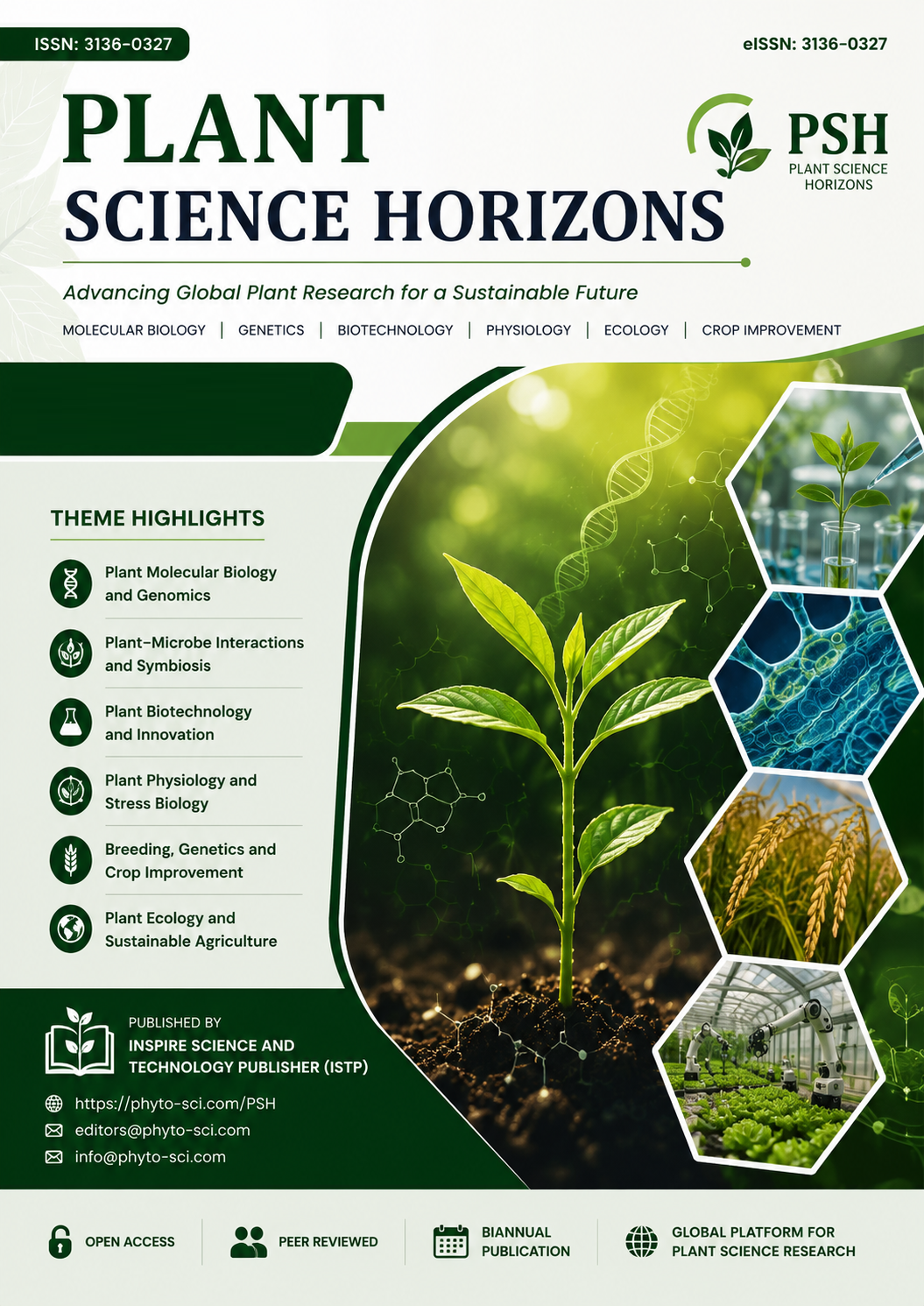
Plant Science Horizons (PSH) publishes rigorous and original research across fundamental and applied plant science. The journal connects molecular and cellular mechanisms with physiology, development, genetics, crop improvement, plant–environment interactions, computational biology, and sustainable agricultural systems.

Biological scale
Molecules to ecosystems
Research mode
Fundamental + applied
Priority
Mechanism + significance
Translation
Crop & sustainability relevance
Approach
Interdisciplinary
01   JOURNAL FOCUS

A broad plant-science journal with defined quality thresholds

PSH provides an international forum for studies that improve understanding of plants as biological systems and as foundations of agriculture, ecosystems, food systems, bioresources, and environmental resilience. The journal considers research on model species, crops, horticultural plants, forest species, medicinal and economic plants, wild plants, and plant-associated organisms when the central scientific question is directly relevant to plant biology.

Breadth of scope does not mean that all technically correct plant-related studies are automatically suitable. Manuscripts should provide a clear scientific advance, robust evidence, appropriate analysis, and conclusions that extend meaningfully beyond a routine description of the study system.

02   SCIENTIFIC MISSION

Connecting mechanism, diversity and application

The journal aims to publish work that explains how plants function, develop, reproduce, adapt, interact, evolve, and respond to environmental change, and how this knowledge can be used responsibly to improve crops and sustainable production systems.

PSH particularly welcomes studies that connect molecular or physiological mechanisms to phenotypes, natural variation, crop performance, ecological function, or practical agricultural outcomes.

03   PLANT CELL & MOLECULAR BIOLOGY

Cellular and molecular mechanisms

Gene regulation and transcriptional networks
RNA biology and post-transcriptional regulation
Protein function, trafficking and turnover
Organelle biology and inter-organelle communication
Cell division, differentiation and polarity
Cell walls, membranes and transport processes
04   GENETICS, GENOMICS & EPIGENETICS

Genome function and variation

  • Genome structure, evolution, pangenomes and structural variation.
  • Functional genomics, comparative genomics and population genomics.
  • Epigenetic regulation, DNA methylation, chromatin biology and epigenome dynamics.
  • Quantitative genetics, association mapping, QTL analysis and genomic selection.
  • Transposable elements, genome duplication and gene-family evolution when linked to biological function or evolutionary insight.
  • Natural variation connecting genotype with phenotype, adaptation, development, or agronomic traits.
05   DEVELOPMENT & REPRODUCTION

Plant growth, development and life-history transitions

Meristems and organogenesis
Root, shoot, leaf and vascular development
Flowering-time regulation and phase transitions
Floral organ development and fertility
Fruit, seed and embryo development
Senescence, dormancy and germination
06   PHYSIOLOGY & BIOCHEMISTRY

Plant function from metabolism to whole-plant performance

  • Photosynthesis, respiration, carbon allocation and source–sink relationships.
  • Primary and specialized metabolism.
  • Water relations, nutrient uptake, mineral nutrition and transport.
  • Redox biology, reactive oxygen species and antioxidant systems.
  • Temperature, light and environmental regulation of physiology.
  • Whole-plant physiological integration and resource-use efficiency.
07   HORMONES & SIGNALING

Signal perception and regulatory networks

PSH welcomes mechanistic studies of phytohormones, peptides, metabolites, calcium, reactive oxygen species, small RNAs, receptor systems, transcription factors, kinase networks, second messengers, and other regulatory mechanisms controlling plant growth, development, immunity, reproduction, and stress responses.

Studies examining signaling crosstalk or spatiotemporal regulation are particularly relevant when the work connects molecular events with a clear biological phenotype.

08   ABIOTIC STRESS BIOLOGY

Environmental stress, acclimation and resilience

Heat and high-temperature stress
Drought and water deficit
Salinity and osmotic stress
Cold, freezing and chilling
Flooding, hypoxia and submergence
Heavy metals and toxic elements
Nutrient deficiency and imbalance
Combined and sequential stresses
09   PLANT IMMUNITY & PATHOLOGY

Biotic interactions, disease and defense

  • Pathogen recognition, immune signaling and defense networks.
  • Plant–fungal, plant–bacterial, plant–viral, plant–nematode and plant–insect interactions.
  • Host susceptibility and resistance mechanisms.
  • Effector biology and host–pathogen molecular interactions.
  • Disease epidemiology when directly linked to plant pathology or crop protection.
  • Genetic, molecular, biological and integrated approaches to durable disease resistance.
10   PLANT–MICROBE INTERACTIONS

Microbiomes, symbioses and the rhizosphere

PSH considers research on beneficial, neutral, and pathogenic plant-associated microorganisms, including rhizosphere, phyllosphere, endosphere and seed microbiomes; mycorrhizal associations; nitrogen-fixing symbioses; microbial signaling; plant growth-promoting microorganisms; and microbiome contributions to nutrition, disease suppression, stress tolerance, and plant performance.

Microbiome studies should move beyond taxonomic description alone and, where feasible, provide ecological, functional, mechanistic, or experimentally validated insight.

11   BREEDING & CROP IMPROVEMENT

Genetic improvement and trait deployment

  • Conventional, molecular and genomic breeding.
  • Marker-assisted selection, genomic prediction and genomic selection.
  • Trait mapping, QTL discovery and validated marker–trait associations.
  • Heterosis, hybrid breeding and population improvement.
  • Germplasm characterization when linked to trait discovery or breeding value.
  • Pre-breeding, introgression and use of crop wild relatives.
  • Breeding for yield stability, quality, resilience, nutrient efficiency and resistance.
12   BIOTECHNOLOGY & GENOME ENGINEERING

Engineering plant traits and biological systems

CRISPR and other genome-editing technologies
Transgenic and cisgenic approaches
Synthetic biology and metabolic engineering
Tissue culture and regeneration biology
Transformation technologies and delivery systems
Biotechnology for trait validation and crop improvement
13   OMICS & SYSTEMS BIOLOGY

High-dimensional biology with biological interpretation

  • Transcriptomics, proteomics, metabolomics, epigenomics and ionomics.
  • Single-cell and spatial omics.
  • Multi-omics integration and network biology.
  • Systems-level modeling of regulatory, metabolic and signaling networks.
  • Large-scale resource studies when the resource itself provides clear and reusable scientific value.
Editorial expectation: Omics studies should not end at lists of differentially expressed genes, metabolites, proteins, pathways, or correlations. Manuscripts should provide clear biological interpretation and, where central claims require it, independent or functional validation.
14   COMPUTATIONAL PLANT SCIENCE

Bioinformatics, modeling and artificial intelligence

PSH welcomes computational methods and analyses that answer substantive plant-science questions or provide broadly useful tools. Relevant areas include genome analysis, network modeling, crop simulation, systems modeling, structural prediction, machine learning, computer vision, remote sensing, phenomics, decision support and artificial intelligence.

Computational manuscripts should demonstrate methodological validity, transparent evaluation, appropriate benchmarking, and biological or agricultural relevance. Simple application of standard software to a small dataset without new insight is unlikely to meet the journal's threshold.

15   PHENOTYPING & DIGITAL AGRICULTURE

Quantifying plant performance at scale

  • High-throughput plant phenotyping and phenomics.
  • Imaging, spectroscopy and sensor-based plant measurements.
  • UAV, satellite and remote-sensing approaches directly linked to plant traits or crop performance.
  • Machine vision and automated trait extraction.
  • Integration of phenotypes with genomic, environmental or management data.
16   AGRONOMY & CROP PHYSIOLOGY

Crop performance and management

PSH considers agronomic and crop-physiology studies on crop growth, yield formation, resource-use efficiency, planting systems, irrigation, nutrient management, crop establishment, canopy function, source–sink relationships, and genotype × environment × management interactions.

Field studies should provide appropriate replication and statistical design and should offer findings that are mechanistically informative, broadly transferable, or important beyond a narrowly local treatment comparison.

17   SOIL–PLANT SYSTEMS

Root environments, nutrients and soil processes

Relevant work includes root architecture, rhizosphere processes, nutrient acquisition, soil fertility, nutrient cycling, soil microbiology, soil amendments, salinity, soil contaminants, plant–soil feedbacks and management effects on plant performance.

Purely soil-focused studies without a clear plant-science question or measurable relevance to plant function, productivity, health or ecology are generally outside scope.

18   ECOLOGY, EVOLUTION & BIODIVERSITY

Plants in natural and changing environments

  • Plant adaptation, plasticity and local adaptation.
  • Plant population biology and evolutionary genomics.
  • Functional ecology and trait-based plant ecology.
  • Plant biodiversity, conservation genetics and restoration where a clear plant-science question is addressed.
  • Plant responses to climate change, elevated CO2, altered precipitation and environmental extremes.
  • Species interactions and ecosystem processes when plant function is central.
19   SUSTAINABLE AGRICULTURE & CLIMATE RESILIENCE

Plant science for resilient production systems

PSH welcomes research linking plant science to climate-resilient agriculture, sustainable intensification, resource-use efficiency, reduced-input systems, biological inputs, diversification, crop adaptation, regenerative practices, and resilience under environmental change.

Sustainability claims should be supported by defined biological, agronomic, environmental or resource-use measurements rather than broad assertions alone.

20   HORTICULTURAL, MEDICINAL & ECONOMIC PLANTS

Diverse plant systems with biological significance

Research on fruit crops, vegetables, ornamentals, plantation crops, spices, beverage crops, medicinal plants, industrial crops and other economic species is within scope when it addresses plant biology, genetics, physiology, breeding, development, metabolism, stress responses, plant–microbe interactions or production biology.

Pure pharmacological, clinical, food-processing or human-health studies in which the plant itself is not a central biological subject are generally outside scope.

21   INTERDISCIPLINARY RESEARCH

Research that crosses traditional boundaries

PSH strongly encourages work integrating multiple disciplines when plant science remains central. Examples include:

Genomics + physiology
Breeding + phenomics
Microbiomes + plant immunity
Modeling + experimental validation
Remote sensing + crop physiology
Ecology + evolutionary genomics
Gene editing + crop improvement
AI + plant phenotyping
22   EDITORIAL PRIORITIES

Characteristics of manuscripts prioritized by PSH

Clear scientific question or hypothesis
Meaningful conceptual, mechanistic or applied advance
Appropriate controls and biological replication
Robust and transparent statistics
Conclusions proportional to the evidence
Functional or independent validation where central claims require it
Data and methods reported sufficiently for evaluation and reuse
Relevance beyond a single narrow experimental context
23   DESCRIPTIVE STUDIES

When descriptive research is suitable

Descriptive work is not automatically excluded. A high-quality genome resource, atlas, biodiversity dataset, mutant resource, phenotypic dataset, reference assembly or other community resource can be valuable even when its primary contribution is descriptive.

However, routine characterization, small catalogues, standard expression profiling, simple diversity surveys or descriptive observations with limited novelty, inadequate validation or little generalizable biological value are unlikely to be prioritized.

24   GENE-FAMILY & IN SILICO STUDIES

Genome-wide surveys must deliver more than annotation

Gene-family identification, phylogenetic analysis, promoter analysis, motif prediction, expression mining and similar bioinformatic surveys are within scope when they lead to a substantive biological, evolutionary or functional advance.

Manuscripts based primarily on routine identification of a gene family followed by standard phylogeny, motif analysis and public-expression plots, without strong new biological insight or appropriate validation, are generally not competitive for publication.

25   FIELD & AGRONOMIC STUDIES

Beyond local treatment comparisons

Agronomic experiments are welcome when they are properly replicated and address a scientific question relevant to plant performance, physiology, resource use, genotype × environment × management interactions, sustainability or crop improvement.

Single-site treatment comparisons with limited replication, little mechanistic interpretation, no validation across conditions, or conclusions that are primarily local management recommendations may be unsuitable unless the findings have clear broader significance.

26   GENERALLY OUTSIDE SCOPE

Studies PSH would normally not prioritize

Work in which plants are incidental rather than the central biological subject
Pure food processing, clinical, pharmacological or human-health studies without a direct plant-biology question
Pure soil chemistry or microbiology without clear relevance to plants
Routine computational surveys lacking new biological insight
Purely descriptive studies of limited scale or general relevance
Methodologically weak studies or studies with inadequate replication
Duplicate, redundant or previously published work
Manuscripts whose central conclusions substantially exceed the available evidence
27   ARTICLE TYPES

Scholarly formats within the journal

Original Research Article
Review Article
Mini Review
Short Communication
Methods / Technical Advance
Perspective / Opinion
Commentary
Spotlight
Editorial
Letter to the Editor
28   AUDIENCE

Who the journal serves

Plant molecular and cell biologists
Plant physiologists and biochemists
Geneticists, genomicists and breeders
Plant pathologists and microbiome researchers
Agronomists and crop scientists
Plant ecologists and evolutionary biologists
Computational and systems biologists
Researchers in sustainable agriculture and crop resilience
29   SCOPE DECISIONS

Scope is evaluated together with scientific quality

A manuscript may fall within a listed subject category but still be declined if it does not meet PSH's requirements for originality, methodological robustness, evidence, reporting quality or broader scientific relevance.

Conversely, interdisciplinary work not explicitly named on this page may be considered when the central contribution clearly advances plant science and fits the journal's readership.

Plant science across scales and disciplines

Plant Science Horizons seeks to publish research that is scientifically rigorous, biologically meaningful, transparently reported and relevant to the international plant-science community. The journal welcomes work ranging from molecular mechanisms and genomic variation to crop performance, plant–environment interactions and sustainable agricultural systems, provided that the study delivers a clear and well-supported scientific contribution.